BlockBlueLight SunDown Taylor Review: a Clear Evening Use Case
We may earn a commission if you buy through this link.
We tried and liked the SunDown Taylor amber glasses. Here is what the brand's light-filtering claim means, who they suit, and what to know about the new-customer offer.
Our verdict
We tried and liked the SunDown Taylor as a focused evening pair. Its amber lenses and clearly stated use case make it easy to understand; consider it for reducing evening blue-light exposure, not as a treatment for eye strain or a guarantee of better sleep.
Why we landed on Good, But Not Essential
We tried and liked the SunDown Taylor as a focused evening pair. Its amber lenses and clearly stated use case make it easy to understand; consider it for reducing evening blue-light exposure, not as a treatment for eye strain or a guarantee of better sleep.
Who we'd buy it for Someone who wants a dedicated amber pair for evening screens and indoor lighting, understands the limits of the sleep evidence, and prefers a defined filtering target to a clear computer lens.
Who we'd tell to skip it You need accurate color for evening work, want glasses to resolve digital eye strain, or expect blue-light filtering to guarantee better sleep.
The part we will not talk past The amber tint changes color appearance, so these are a poor fit for work where accurate color matters.
Pros
- We tried and liked the SunDown Taylor's focused role as an evening pair rather than an all-day eye-strain solution.
- BlockBlueLight publishes a wavelength range for its 100% blue-light-blocking claim, giving shoppers a specific claim to assess.
- The lighter amber tint is designed to preserve more color perception than the brand's red lenses.
- The product page lists frame dimensions, lens options, and a carry case and lens cloth.
Cons
- The amber tint changes color appearance, so these are a poor fit for work where accurate color matters.
- The 100% filtering figure is a BlockBlueLight claim, not a Well Worth It Lab measurement.
- Blue-light glasses are not well supported as a fix for digital eye strain, and a filtering claim does not guarantee an improvement in sleep.
- The $89.95 listed price is for the non-prescription version; readers and prescription lenses cost extra.
We tried and liked the BlockBlueLight SunDown Taylor as a focused pair for the evening. Its amber lenses have a clear role: reduce exposure to blue wavelengths from screens and indoor lights after sunset. That is a more useful reason to consider them than a promise to fix tired eyes or transform sleep.
The non-prescription black pair is listed at $89.95. The supplied referral offer gives eligible new customers 10% off automatically through our tracked link, making $80.96 an estimate before tax and shipping. Readers and prescription lenses cost extra. See our BlockBlueLight offer page for the current link and eligibility note; no promo code is needed.
What we like about the SunDown Taylor
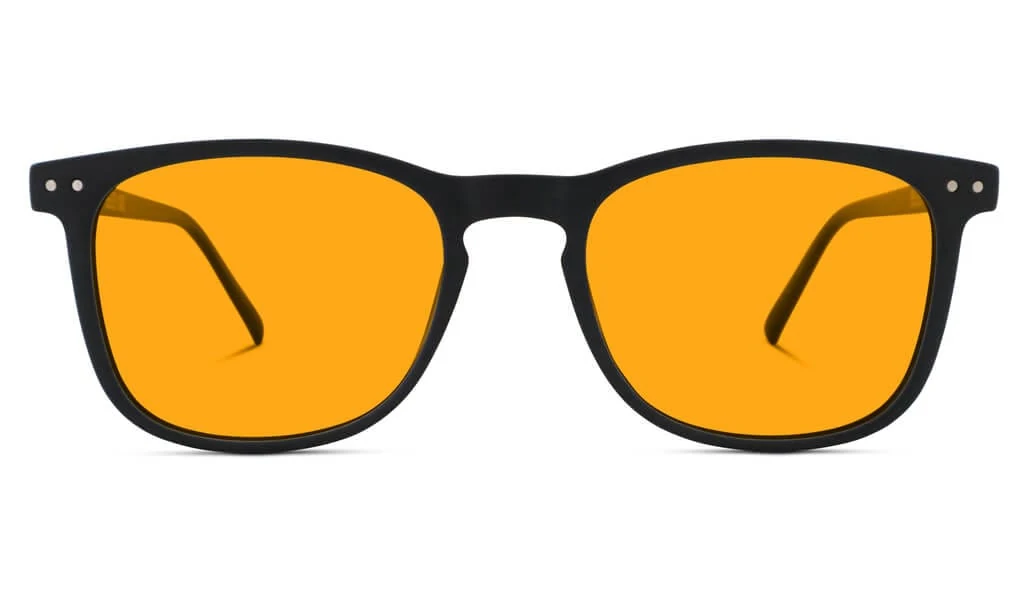
The strongest case for this pair is how specific it is. The SunDown amber lens is intended for evening use, when someone wants to reduce blue light from artificial sources without choosing the deeper red tint the brand uses for more extensive filtering. We tried the Taylor and liked it as an easy-to-understand evening option. We are keeping that recommendation narrow: we are not claiming a measured sleep improvement, a fit for every face, or a measured reduction in eye strain.
BlockBlueLight says the amber lenses block 100% of blue light from 400 to 500 nm and links a Spectrum Report on the product page. That is a concrete, useful claim to compare, but it remains the manufacturer’s claim. We have not independently measured transmission through this pair.
The official listing describes acetate frames with stainless-steel spring hinges and includes a carry case and lens cloth. Its listed measurements are 131 mm frame width, 51 mm lens width, 41 mm lens height, 20 mm bridge, and 148 mm arm length; the listed weight is 26 g. Those details make it easier to compare the frame on paper with glasses you already own. They do not tell us how it will fit an individual face.
A reasonable evening filter, not an eye-strain fix
The product’s evening-light use case is plausible, but it needs careful wording. Filtering a particular wavelength range changes the light reaching your eyes; it does not prove these glasses will make you sleep better. Individual outcomes depend on a broader evening routine, lighting, timing, and other factors.
We would not choose the SunDown Taylor to treat digital eye strain. Our blue-light glasses guide reviews why blue-light-filtering lenses have not reliably outperformed clear lenses for that complaint, and points to screen distance, glare, room lighting, and regular breaks as more practical places to start. The glasses may still suit someone who wants an amber filter after sunset; that is a different goal.
The tint is a real trade-off. Amber lenses change how colors look compared with clear lenses, so they are not ideal for color-sensitive work. BlockBlueLight positions this amber option as lighter and better for color perception than its red lenses, but it remains a tinted lens.
Price, lens choices, and the current offer
BlockBlueLight lists the non-prescription SunDown Taylor at $89.95. Readers are listed at an additional $35 and prescription lenses at an additional $75. Those options change the starting total, so do not apply the basic-price estimate to them.
The supplied partner offer is 10% off for eligible new customers through our referral link. That puts the current $89.95 non-prescription price at an estimated $80.96. The final price depends on the customer’s eligibility and selected lens option; confirm the discount in the cart. Visit the BlockBlueLight promo page for the link and current offer details.
Our verdict
The SunDown Taylor is a good, focused evening pair for someone who already wants an amber filter and values having a stated wavelength target and usable frame measurements. We tried it and liked it in that role. The new-customer link offer improves the price, but the brand’s filtering percentage is not an independent measurement, and the product should not be sold as an eye-strain treatment or a guaranteed sleep aid.
Compare the official SunDown Taylor product details, read our blue-light glasses guide, and check the current BlockBlueLight offer before buying. We may earn a commission if you shop through our referral link, at no extra cost to you.
Who it's for
Someone who wants a dedicated amber pair for evening screens and indoor lighting, understands the limits of the sleep evidence, and prefers a defined filtering target to a clear computer lens.
Who should skip it
You need accurate color for evening work, want glasses to resolve digital eye strain, or expect blue-light filtering to guarantee better sleep.
In this review
- SunDown Taylor Blue Blocking Glasses - Black
$89.95before offer$80.96estimated with10% off for eligible new customers through our referral linkEstimated saving$8.99 (10% off)with this offerPrices change often; use the retailer link for the current price.
SunDown Taylor Blue Blocking Glasses - Black
Good, But Not Essential
We tried and liked the SunDown Taylor as a focused evening pair. Its amber lenses and clearly stated use case make it easy to understand; consider it for reducing evening blue-light exposure, not as a treatment for eye strain or a guarantee of better sleep.
Frequently asked questions
What does BlockBlueLight say the SunDown Taylor filters?
Can the SunDown Taylor help with digital eye strain?
Will these glasses improve my sleep?
What lens options and sizes are available?
How do I get the 10% BlockBlueLight offer?
Affiliate disclosure
Some links on this page may be affiliate links — we may earn a commission if you buy through them, at no extra cost to you. We only recommend products we think are worth considering. Verdicts are not influenced by commissions.
Health disclaimer
This content is for informational purposes only and is not medical advice. Talk to a qualified professional before starting new supplements, treatments, or major health changes.