Cobra OPTM MAX-D Driver review: is the draw-biased model worth $599?
Listed price $599 shown on the official Cobra Golf page when checked September 6, 2026 Price snapshot: September 6, 2026. Confirm the final total at checkout.
View at COBRA Golf →We may earn a commission if you buy through our links or codes.
A targeted draw-biased option for the right golfer, but not a substitute for fitting or a guaranteed slice fix.
Our verdict
A targeted draw-biased option for the right golfer, but not a substitute for fitting or a guaranteed slice fix.
Why we landed on Good, But Not Essential
A targeted draw-biased option for the right golfer, but not a substitute for fitting or a guaranteed slice fix.
Who we'd buy it for Golfers with a repeatable right miss who want to test a high-launch, heel-weighted driver with a more stable 460cc shape.
Who we'd tell to skip it You already draw or hook the ball, need a neutral/low-spin head, or are hoping a new driver will replace a fitting or swing change.
The part we will not talk past The $599 price makes a fitting or demo important before buying for slice correction.
Pros
- Cobra positions the 460cc MAX-D around stability, higher launch, and draw bias.
- The fixed 11g heel weight gives the model a clear purpose instead of vague all-around positioning.
- FutureFit33 offers loft-and-lie adjustment up to two degrees in either direction.
Cons
- The $599 price makes a fitting or demo important before buying for slice correction.
- Draw bias can be the wrong fit for golfers who already turn the ball over or want to work it both ways.
- The live selector and comparison table showed different loft availability when checked; confirm the actual configuration.
- Cobra's straighter-flight, side-spin, and distance language is manufacturer positioning, not independent launch-monitor evidence.
We’d buy the Cobra OPTM MAX-D if you have a repeatable right miss and you want to test a high-launch, heel-weighted 460cc driver. We’d skip it if you already draw or hook the ball, you need a neutral or low-spin head, or you are hoping a new driver will replace a fitting or a swing change. Draw bias is not a guaranteed slice fix, and $599 is too much to spend without checking the actual loft in the live selector.
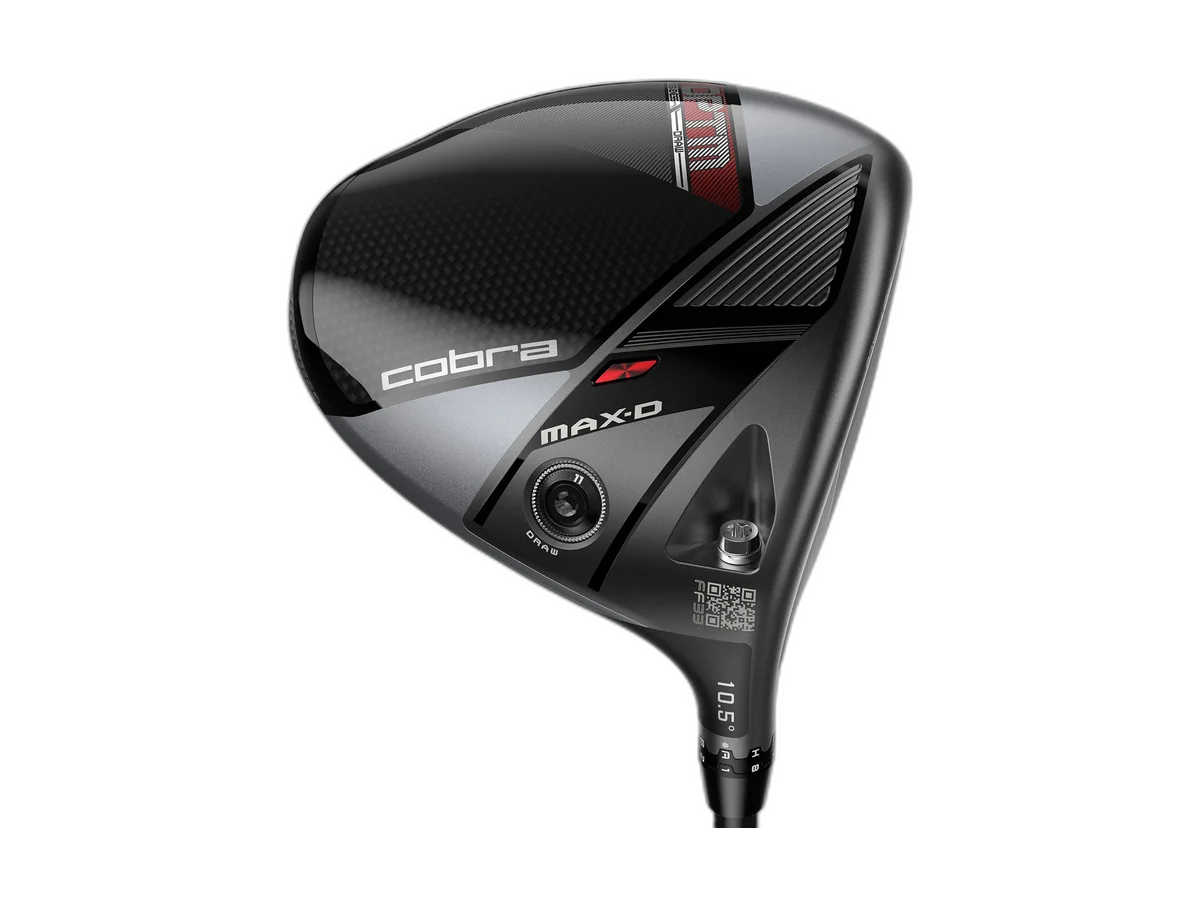
The Cobra OPTM MAX-D Driver is the most targeted member of the OPTM lineup, built specifically for golfers who fight a repeatable right miss. Cobra’s official page lists a $599 price, a 460cc oversize head, FutureFit33 loft-and-lie adjustment, a fixed 11g heel weight, and a standard 45.50-inch length, positioning the club around higher launch, slice correction, stability, and straighter shots.
The fitting question it answers is direct: does a draw-biased, heel-weighted 460cc head improve a golfer’s repeatable right miss without creating a new left-side problem? This is a review of whether this is actually worth the bag slot — we have not hit the driver or measured carry, dispersion, or launch against a neutral head, so treat the case below as a strong fitting candidate to test.
Quick answer
The MAX-D is a strong fitting candidate for a golfer with a consistent right miss who wants to test draw bias — the fixed heel weight and higher-launch positioning give it a clear purpose most drivers don’t have. It is not a guaranteed slice cure, and it is not the right default for a golfer who already turns the ball over.
The draw bias is a design direction, not a result guarantee. A golfer’s face-to-path, strike location, loft, shaft, and setup still determine where the ball starts and curves. If the miss is inconsistent, a fitting or lesson may be more useful than buying a new head first.
What Cobra’s page supports
Cobra describes the MAX-D as a 460cc oversize driver with maximum stability and draw bias. The page says strategic weight placement and a center of gravity closer to the hosel are intended to promote higher launch, faster face closure, and a straighter flight.
The fixed heel weight is the important differentiator. Cobra lists an 11g heel weight and says the placement is intended to make the face easier to close. That explains why this model exists; it does not mean every golfer will see a straighter shot.
The product page also describes a forged face insert with H.O.T. Face technology and the broader OPTM shaping intended to reduce side spin and maintain speed on off-center strikes. These are manufacturer claims and engineering explanations, not independent test data.
Loft and stock details need a live check
The page’s comparison table lists 9.0°, 10.5°, and 12.0° loft options, with a 61-degree standard lie and a 45.50-inch length. The live product selector showed 10.5° and 12.0° choices when checked, so the exact availability appears to depend on the current configuration and stock.
The stock table lists MCA Kai’li Dark Waves Red 50 and MCA Vanquish 40 options across regular, senior, and lite configurations. Cobra also describes a lighter custom build that can reduce total weight, but custom availability and final specifications should be confirmed with the live selector or customer service.
That variation matters. A draw-biased head with the wrong loft or shaft can still be a poor fit, and the same head can feel very different across standard and lightweight builds.
FutureFit33 is a fitting tool, not a magic setting
Cobra describes FutureFit33 as 33 loft-and-lie settings with adjustment up to two degrees in either direction. SMARTPAD is intended to keep the face square as the setting changes.
For a golfer who knows the start line and launch window that need work, those settings add useful flexibility. For a golfer who is simply hoping to find a magic “straight” setting, they can create more confusion. Start with a measured miss, then change one variable at a time.
Who should consider the MAX-D?
The best fit is a golfer who:
- misses right often enough that draw bias is a repeatable fitting question;
- wants a larger 460cc profile and more stability than a compact control head;
- needs help launching the ball higher; and
- can compare the MAX-D with a neutral head using the same or comparable shaft.
The MAX-D deserves caution when:
- your normal miss is left or you already draw the ball;
- you want to intentionally work the ball both ways;
- your low flight is caused by strike or delivery rather than head design; or
- you expect the club alone to repair a severe slice.
The Cobra OPTM driver comparison lays out the MAX-D against the LS, X, MAX-K, and LS Tour Length models.
What to verify before checkout
- Current price, stock, and the exact lofts shown in the live selector.
- Handedness, shaft, flex, grip, length, and standard versus lightweight build.
- Launch, spin, start direction, and dispersion against a neutral driver.
- Whether the heel bias reduces the right miss without creating an unplayable left miss.
- Return, warranty, fitting, and custom-order terms for the selected configuration.
Cobra’s page states that custom club builds ship in 3–5 business days, but timing can vary with the selected build and inventory. Treat that as a current page estimate, not a promise.
Final verdict
The Cobra OPTM MAX-D is a sensible, well-targeted option for a golfer with a repeatable right miss. It has a clear design purpose, a stable 460cc shape, and useful loft-and-lie adjustment — a strong starting point once a fitting confirms the draw bias helps. Let the actual ball flight against your current or a neutral driver make the final call on the $599 price.
Read the Cobra OPTM driver comparison, verify the official OPTM MAX-D page, and use the approved tracked link if the fit matches your game. Well Worth It Lab may earn a commission from this link, at no additional cost to the buyer.
Who it's for
Golfers with a repeatable right miss who want to test a high-launch, heel-weighted driver with a more stable 460cc shape.
Who should skip it
You already draw or hook the ball, need a neutral/low-spin head, or are hoping a new driver will replace a fitting or swing change.
In this review
- Cobra OPTM MAX-D DriverPrices change often; use the retailer link for the current price.
Cobra OPTM MAX-D Driver
Good, But Not Essential
A targeted draw-biased option for the right golfer, but not a substitute for fitting or a guaranteed slice fix.
Frequently asked questions
Is the Cobra OPTM MAX-D Driver worth $599?
Does the Cobra OPTM MAX-D fix a slice?
What makes the OPTM MAX-D draw biased?
What lofts does the Cobra OPTM MAX-D have?
Does the OPTM MAX-D have adjustable loft?
What should you still check before you buy?
Affiliate disclosure
Some links on this page may be affiliate links — we may earn a commission if you buy through them, at no extra cost to you. We only recommend products we think are worth considering. Verdicts are not influenced by commissions.